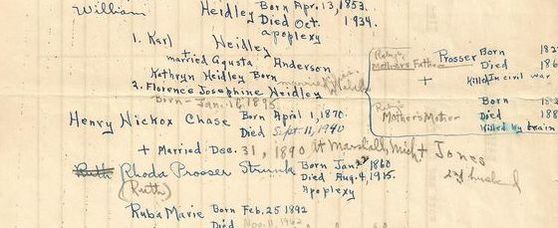
One of the ancestors I had on my list to look for was my great-grandfather Henry Hickox Chase.  I knew from family records that he entered the Traverse City State Hospital in 1936 and was there until he died in September 1940.
    I spent some time on Google Maps and Google Earth, trying to pin down the ED for the hospital.  Turns out I didn't need to go to the trouble, since the State Hospital had an ED all to itself: 28-18.  
    What I wasn't prepared for was how big this institution was in 1940!  The first four pages enumerated over 160 hospital employees, including physicians, therapists, dentists, psychologists, nurses, clerks, cooks, bakers, kitchen helpers, dietitians, housekeepers, maids, seamstresses, laundry workers, telephone operators, and student nurses.  When at last the roster of inmates began, they were listed in alphabetical order.  I quickly scrolled through page after page until I got to the "C"s, and was momentarily taken aback when H.H. Chase wasn't listed.  Then I realized that they began with the listing of women patients.  This listing of just the females went on for over 25 pages - well over 1200 women.  When I got to the list of men patients, there he was:
Picture
1940 U.S. census, Grand Traverse, Michigan, population schedule, Traverse City, enumeration district (ED) 28-18, sheet 19B, Henry H. Chase, digital images, Ancestry (http://www.ancestry.com: accessed 8 Apr 2012); citing NARA microfilm T627, roll 1753.
     He was listed as age 69, although he had actually just turned 70.  He was divorced, and had an 8th grade education.  In 1935 he was living in his own home in Bear Lake, Manistee, Michigan.
     I thought I knew what I was expecting to find on the 1940 census.  But I'm finding out that this census is giving me a clearer picture of the life and times, and the surroundings each of my ancestors was living in.  Where before I may have imagined that Henry H. Chase spent his last years in something approaching a nursing home or assisted living facility, now I have the image of something closer to the truth - of many brick buildings, housing well over 2500 inmates, all of them mentally ill.

Picture
Henry Hickox Chase, 1870-1940
 
 
     The 1940 census is here!!  I will have to admit that after all the hype, I was a little disappointed (but not surprised) that I wasn't able to get in to the NARA website to view images.  As the National Archives put it the following day, they were expecting a tidal wave and got hit with a tsunami!  
1940 census archives.com
Picture
    The first census discovery I wanted to make was finding my mother, Mary Elizabeth Stoelt, living with her parents on 14883 Faust in Detroit, Michigan.  Using Steve Morse's website, I was able to narrow down the Enumeration Districts to 1604A and 1604B.   When I was finally able to view images on the day after the release, I scrolled through 32 pages of ED 1604A and 8 pages of ED 1604B before I found them.

    I was surprised by a number of things on this census.  The circled X next to my grandmother's name meant that she was the one giving the information to the census taker.  However, given that she was a high school English teacher, the errors are surprising.  My grandfather's middle initial was A, not L, and Ervilla's name is spelled Ervilia.  This leads me to believe that my grandmother was answering the census taker's question orally, and that the answers were written down as they were heard.

     It was also interesting to see that their housekeeper was enumerated with the family.  I remember my mother talking about Bernice, but I was under the impression that she was black, and came in for the day.  According to the 1940 census, Bernice Robinson was a 26 year old white woman, born in Michigan, who lived with the family.  My mother's family needed the help, because both her father and stepmother worked full-time; Arnold Stoelt was a printer at the Detroit Free Press and Ervilla taught school.
     It was at once satisfying, and strange, and sad, to see my mother's name on her first census record.  She missed being on the 1930 census by a year (my father missed it by 4 days).  I have lots of memories visiting that ivy-covered brick house in Detroit when I was a young girl, and now I have another picture in mind - of my grandmother Ervilla, standing in the front door of that house, answering the census-taker's questions.
     
Picture
Mary Elizabeth Stoelt in 1942, holding her baby sister Ethel.
 
 
    My friend and colleague Michael Hait wrote a blog post after he discovered a song he'd never heard before, called "I'm My Own Grandpa".  This brought back memories for me, because this was my father's favorite song, and we all would sing the chorus along with him.
    You can hear the Muppet Jugband singing it here on YouTube:


    I'm a little late in getting started, but I have finally started making my list(s) of who I'm going to look for in the 1940 census, for myself and my clients.  This census is especially exciting for me, since I was not involved with genealogy 10 years ago when the 1930 census was released, and therefore missed the excitement then.  Also, this is the first census to be released digitally - no more going to the National Archives branch on Sand Point Way in Seattle, to crank the handles of microfilm readers!
    One of the most important reasons I like to keep my records in a genealogy software program (Legacy Family Tree) on my computer is the ability to run specialized reports.  For instance, I can run a report that will list everyone born in Medina County, Ohio after 1900, or generate a list of people who died in Michigan before 1920.  The most recent report I've run for myself and my clients is a list of those people who were born before 1940 and died after 1940.
    My own list of 577 names (out of a database of 3400) includes both sets of grandparents: my maternal grandfather Arnold A. Stoelt and his second wife Ervilla, living at 14883 Faust St. in Detroit, and my paternal grandparents Maurice and Ruby Reed, living at 1030 E. St. Joseph St. in Lansing.  I imagine that both these families were grateful to have made it through the Great Depression with steady employment - Arnold Stoelt was a printer at the Detroit Free Press, and Ervilla taught high school English, while Maurice Reed was a truant officer for the Lansing Public Schools.
    Since it will be released digitally with images only, there won't be a searchable index for several months.  I am fortunate that I know where both sets of my grandparents lived in 1940, and I can determine the Enumeration Districts (ED) to look at.
    To do that, I used Steven Morse's website on obtaining Enumeration Districts for large cities: 
http://www.stevemorse.org/census/.  I selected the state (Michigan), the city (Detroit), and then selected the street (Faust).   It gave me a list of 17 ED's, but I can narrow it down further by selecting the nearest street that crosses Faust.  I looked it up on Google Maps, and found that the nearest street was Chalfonte.  That narrows the possible ED's down to 2 - a much smaller target!
    My great grandparents Percy and Mary Reed, however, lived in Beulah, a tiny village on the shores of Crystal Lake, in northwest Michigan.  In order to determine their ED, I used Steven Morse's conversion tool, which converts the 1930 ED to the ED used for the 1940 census,
hereTheir 1930 ED was 10-3, and using the conversion tool I can see that I need to look at ED 10-3 and 10-4 in 1940.  However, I can narrow it down further by looking at the 1940 ED map of Beulah, using the 1940 ED map finder, here.
   
   
    On this map, it's easy for me to see that ED 10-4 is the one I want to look at, since I know that Percy and Mary lived in that section of Beulah (which is spelled wrong on the map).
    My great grandfather Henry Hickox Chase, in 1940, was a resident of the Traverse City State Hospital, having been diagnosed with a form of dementia in 1936.  It took me a combination of Google Earth, Wikipedia, and a private website to determine that the hospital was (more or less) at the cross streets of Elmwood and 11th in Traverse City.  The ED here is 28-17.
    My great great grandfather Stacy Clay Thompson was living in Manistee, Michigan, with his second wife Marian.  His address on the 1930 census was 214 Arthur Street, and on the 1940 census I will want to look at ED's 51-9 and 51-10.
    For my clients, I will be looking at ED's in Milwaukee, Wisconsin, Montgomery County, North Carolina, Seattle, Washington, Mercer County, Ohio, Philadelphia, Pennsylvania, and various small towns in Minnesota. 
    I can tell I'm going to be busy, come April 2.  Who will you be looking for on the 1940 census?


     Last month I received an email from the president of our local chapter of the Association of Professional Genealogists - he'd gotten an email from the Black Diamond Police Department, requesting our help.  I volunteered for the case, since I live in Maple Valley, just a stone's throw away from Black Diamond. 
     In January someone turned in an urn of ashes that was found in the storage area of the basement of the Black Diamond Bakery.  The urn was labeled with the birth and death dates for Helen C. Morrison, who died Sept. 19, 1977.

Picture
“Helen Morrison”, Record-Chronicle, 23 Sept. 1977, p.4
     When I met with Sergeant Brian Lynch, he gave me the photo of the urn (being stored in his evidence locker), and the obituary he'd obtained from the Seattle Public Library.  With the clues given in the obituary, I was fairly sure I could come up with the names of some living family members that we could give the ashes to.

     I have been doing genealogical research for a long time, but I have never seen a case like this one where there were so many errors in the records.
     I began with Helen's daughter, Ruth Kurtti.  I found her cemetery record on Find A Grave, and her gravestone indicated she'd died in 1979; however when I checked Ancestry, I found that her actual date of death was 13 Jan 1980, as given on the Oregon Death Index.  I found the death date for her husband, and emailed the Astoria Public Library for their obituaries.  Those obituaries gave the name of their surviving daughter.

     Next I decided to investigate Helen's sister Charlotte Balloway, only to find that on Washington Digital Archives there was no such person.  Figuring from the obituary that Helen's (and Charlotte's) maiden name was Cook, I looked for the marriage of Charlotte Cook - and soon found that Charlotte Cook married John Galloway in 1917 in Snohomish County.
     Looking at the 1920 census of Snohomish County, I discovered that Charlotte Galloway was born in Iowa, and that her father was born in England and her mother in West Virginia.  The 1900 census of Wapello, Richland County, Iowa revealed that "Ellen" was born in October 1891, not 1880.


Picture
1900 U.S. census, Wapello, Iowa, Richland population schedule, enumeration district (ED) 137, sheet 12A, p.334 (stamped), dwell. 259, fam. 265; digital image, Ancestry (http://www.ancestry.com: accessed 12 Feb 2012); citing NA microfilm T623, roll 463.
     Then I started looking for census records here in Washington that might include Helen and her children - William, Charles and Ruth.  I soon found them on the 1920 census of Earlington, near Renton:
Picture
1920 U.S. census, King, Washington population schedules, Earlington, enumeration district (ED) 15, sheet 3A, p. 171 (stamped), dwell. 54, fam. 55; digital image; Ancestry (http://www.ancestry.com: accessed 15 Feb 2012); citing NA microfilm T625, roll 1924.
     On this census, Helen's husband was listed as Columbus Morrison.  That led me to their marriage record (in 1908 in Seattle), and to his 1951 obituary in the Seattle Daily Times.
     From the census records I figured that Ruth Morrison was born about 1909, William about 1912, and Charles about 1914.  My next step was to look for Washington Death Records - and found that a William E. Morrison (born about 1912) had died in Renton on 10 December 1985 and Charles L. Morrison (born about 1915) had died in Issaquah on 6 April 1981.  A trip to the Kent Library to look at their South King County newspapers yielded this obituary for William:

Picture
"William 'Ed' Morrison", News-Journal, 13 Dec 1985.
Picture
"Charles L. Morrison", Seattle Times, 7 Apr. 1981, p.D6.

     After exploring some online directories, I was able to determine that Barry Morrison probably still lived in Kent.  I sent this email to Sergeant Lynch: Here’s the information:
  Junetta C. Brown, age 64, lives in Seaside or Cannon Beach, Oregon.
 She is the daughter of Ruth Morrison Kurtti, who was Helen C. Morrison’s daughter.

Barry J. Morrison, age 65+, lives on SE 227th Pl. in Kent.  He is the son of William “Ed” Morrison, who was the son of Helen C. Morrison.

Leonard E. Morrison was living in Kent in 1986.  He is the other son of William “Ed” Morrison, son of Helen C. Morrison.
From this information, Sgt. Lynch was able to contact Barry Morrison, who was astonished to learn that his grandmother's ashes were in the evidence locker at the Black Diamond Police Department.  On Tuesday, March 6, we met with Barry and his family to formally turn over the ashes, and celebrate a successful conclusion of a puzzling case!
Picture
L to R: Claudia Breland, Sgt. Brian Lynch, Barry Morrison with his granddaughter and wife. Photo courtesy of The Voice of the Valley, c.2012.
Picture
Helen Morrison with her grandson Barry, age 2 years. Photo courtesy of The Voice of the Valley, c.2012.
 
 
     With NBC's "Who Do You Think You Are?" in its third season, I'm finding that I can't get enough of genealogy on TV!  A good complement to that show is The Generations Project, which is produced by BYU-TV.  Rather than following celebrities, they take an ordinary person like you or me, who has a compelling reason for exploring their ancestry, and follow them through that journey.
     Here's a preview of one of last season's episodes:


     According to the count-down calendar on Ancestry, it's only 40 days until the release of the 1940 census!  What will you find there?  Who will you look for, and where will you look for them?  To get a start, you can view the introductory video on the National Archives website here.
     After you see the video, you can visit the National Archives website to read about finding your relatives and ancestors on the 1940 census returns, even before they're indexed.  You can start by making a list of parents, grandparents and great-grandparents, and note where they were living in 1930, and where you think they were living in 1940.
     Here's my list:
Arnold and Ervilla Stoelt - Detroit, Michigan
Maurice and Ruby Reed - Lansing, Michigan
Henry Hickox Chase - Traverse City, Michigan
Percy and Mary Reed - Beulah, Michigan
Herbert Kenny Randall - Detroit, Michigan
Stacy and Marian Thompson - Manistee, Michigan

     Of course, they're just the beginning of the list of people I'll want to find.  For all the cousins, aunts and uncles who I've found on the 1930 census, I'll use my genealogy software (Legacy Family Tree) to generate a list.  It's as simple as asking it to find everyone who was born before 1940 and died after 1940.  My search of my database (with over 3000 names) yielded an 18-page list of over 500 people! 
     Another thing I'm doing to get ready is indexing for FamilySearch.  You can sign up here - it's easy and fun, and contributes to all of us who are searching for our ancestors!
the1940census.com
 
 
     Living in Maple Valley, just southeast of Seattle, Washington, we are generally safe from major weather events.  We don't get hurricanes or tornadoes or blizzards.  We don't even see much snow; our winters are generally more rain than snow.  We've had snow on Christmas Day for 2 out of the past 33 years.
     But when we do get a major snowstorm, it's a news event.  This past week we've been hit with snowstorms and ice storms, prompting our governor to declare a state of emergency.
Picture
"State of Emergency declared as Washington freezes"; digital image, King5 News (http://www.king5.com: accessed 19 Jan 2012)
     I'm very grateful to still have power, light and warmth - and a good internet connection!  I've been remembering times past, when we've lost power for days at a time, and kept a fire burning in the fireplace while my children did homework by lamplight.  We have documented in our photo albums the Inaugural Day storm of 1992, when trees came down in our back yard, and the local grocery stores had generators going until power was restored.  In my Christmas letter of 2003 I told of the high winds that hit our area and blew part of the roof off the elementary school: "Steven's school was badly damaged, and was closed for a week for repairs to the roof.  His classes are meeting in the gymn until after Christmas break."  My children will undoubtedly be telling their children about the "olden days", when they had to do without TV, computers and internet because of severe weather.
     In thinking of how my ancestors coped with severe weather, I immediately thought of the great Blizzard of 1888 that hit New York City.  Grandma Stoelt's great-grandfather John Christopher Varran and his wife Margaret, both in their 60's, lived in New York City, at 301 S. 121st St.

Picture
"New York City Directory", 1888 edition, p.2018, John Varran; digital image, Fold3 (http://www.fold3.com: accessed 19 Jan 2012)
     I wonder what their experience was, living through the blizzard.  Obviously they survived - although John Varran died just two years later in 1890, Margaret lived until 1918.  Did they have a wood or coal stove to warm their home?  Did they have enough food?  In some ways, looking out at the snow and ice surrounding them was very similar to mine, 124 years later, on the other side of the country.
     But most of my ancestors were living in Michigan, and the worst storm there was the Big Blow of November 1913. 
Picture
"Fierce Storms Sweep Country", Grand Rapids press, November 10, 1913; digital image, GenealogyBank (http://www.genealogybank.com: accessed 19 Jan 2012)
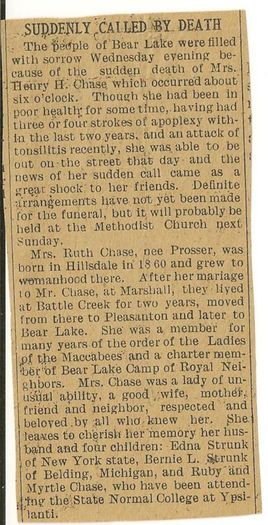
     In 1913  my great grandparents Henry and Ruth Chase were living in Bear Lake, Manistee County, just a few miles from Lake Michigan.  My great grandparents Percy and Mary Reed lived in Beulah, also close to the Lake Michigan shoreline.  Their children, Ruby Chase and Maurice Reed, were attending Michigan State Normal College in Ypsilanti (Ruby) and Michigan Agricultural College (Maurice) in Lansing, but I'm sure they were affected by the storm as well. 
     As for my maternal great-grandparents, Herbert and Claudia (Thompson) Randall were greatly affected by the storm - they lived in Manistee, right on Lake Michigan, and Herbert worked as a ship's engineer.  Herbert's father Augustus Randall and Claudia's father Stacy Thompson lived in Manistee, as well.  As for the Stoelts, my grandfather Arnold Anthony Stoelt was 12 years old and living in Sebewaing, Huron County, with his parents Johan and Catherine (Dorsch) Stoelt.  In fact, looking at the dates, I see that Johan Stoelt died just weeks later, on 26 December 1913.
     So in dealing with the weather, stocking emergency supplies and coping with power outages and downed trees, we have a lot in common with our ancestors.  Today's ice storms are tomorrow's stories ~ just as I tell stories of living through hurricane watches and warnings in Florida in the 1970's, someday my children will be telling their grandchildren about the high winds they experienced in Western Washington, lo these many years ago.
 
 
     When I was a little girl, living with my family in Cincinnati, we used to drive to Michigan several times a year to visit relatives.  My favorite destination was the little village of Beulah, on Crystal Lake, where my Grandma and Grandpa Reed had built a cottage in the 1940's and named it Columbine Cottage for the wildflowers that grew there.
     On one of these trips - and I'm not certain if it was before my Grandma Ruby Reed died in 1963, or afterwards - I was given something magical, that delighted my reader's heart.  It was a scrapbook that Grandma Ruby had put together of some children's stories about Santa Claus, that were published in ladies' magazines in the 1920's.  They were written by Sarah Addington and illustrated by Gertrude Kay. 
     The stories had been cut out of the magazines and carefully pasted into a homemade scrapbook between stiff cardboard covers.  The lined notebook pages are yellowing with age, and the masking tape binding is disintegrating, but the newsprint is as readable as ever.  Some of the stories were too large for the page, so my grandmother had taped and glued these sections so that they would fold out and up, just like a pop-up book.
     The first story was "There Was a Boy Who Lived on Pudding Lane", subtitled, "A True Account, if Only You Believe it, of the Life and Ways of Santa, Eldest Son of Mr. and Mrs. Claus".  In these stories the author seamlessly and believably (at least to an 8-year old girl) interweaves her version of Santa Claus with all the Mother Goose nursery rhymes and stories.  This one begins:
     Once upon a time in the kingdom of Old King Cole there lived a father and a mother and a fat little boy who always dressed in a bright red suit.  The father, whose name was Mr. Claus, was a baker, and he lived on Pudding Lane, between the butcher and the candlestick-maker.
     Mr. Claus was really about the best baker in the world. He knew so well how to make little cake puppies with red currant eyes. And he knew so well how to make funny gingerbread Brownies with black raisin eyes. He made great fat loaves of bread, warm and golden and crusty. And he made little plum tarts that a boy could eat up in one gobble, and a girl could eat up in two.
     The story goes on to tell how Santa grew up, with his younger brothers (who arrived as two sets of twins and named Matthew, Mark, Luke and John) and younger sister, how all the children of the village loved Santa because he would give away cookies from his father's bakery, and that he was especially loved by his grandmother, Mother Goose herself.  And it tells how Santa saved all the village children from following the Pied Piper by promising to make every child a toy for next Holy Day.   It tells how he married Bessie, the candlestick-maker's niece, and how Old King Cole set him up in the North Country with sleighs, reindeer, and a great workshop. 
     All year long Mr. and Mrs. Santa Claus worked to make toys. Santa cut down straight pine and spruce trees.  He carved dolls and horses and rabbits out of wood, and Mrs. Claus painted them until her arms ached. He made dolls of sawdust and linen, and Mrs. Claus dressed them in the latest doll styles, in blue and pink silk, with lace on the edge of their bonnets. Santa made a roomful of rocking horses; it seemed that every little boy in the world wanted a rocking horse. And Mrs. Claus made candy until she said she thought she'd turn into candy.  Whereupon Santa told her she was sweet enough for that anyway!
     And so it is that Santa Claus has come every year since that first Christmas, and will keep on coming - forever.
Citation: Addington, Sarah. "There Was a Boy Who Lived on Pudding Lane. Ladies Home Journal, December 1921, p.12.
 
 
     Some of the bloggers I read have been posting "If Our Ancestors Wrote Christmas Letters", and I have been thinking about doing the same.  However, until I do, here's a blast from the past - a Christmas letter my dad wrote from Cincinnati, Ohio in December 1960:

Dear Kinfolk and friends,
     I have so enjoyed "annual family status reports" received from friends and relatives at this time of year in the past that I'm trying it out myself this year.  First, let me start off with a hearty, "BEST WISHES FOR A HAPPY HOLIDAY SEASON," to all.
     Since November 19th of 1959, when Craig Cameron was born, we have been a family of five.  Christopher Chase (3 1/2) and Claudia Catherine (6) are the other children, with Mary and myself completing the roster.  A split level house in Forest Park (a suburban development about 5 miles north of Cincinnati) is the place we call home.  At the present time we are all healthy and happy and sharing the childrens anticipation and excitement about Christmas.
     A year ago, things were not as settled.  Mary and Craig came home from the hospital the day before Thanksgiving.  I took "vacation" to help Mary at home.  With an "innocence is bliss attitude" prepared a huge turkey.  About the time I got a dozen eggs, a quart of oysters, a dishpan full of breadcrumbs and all the sage I could find in the house mixed together for the stuffing, I began to have a few misgivings.  For the first attempt, the results were nearly amazing...the bird was delectable.
     With the hubbub connected with adjusting family routine to a new baby, last Christmas was kind of hectic.  But for the young ones, it was the culmination of their weeks long dreams.  For Mary and me, it was somewhat of an anti-climax since our big present (Craig) had already arrived.
     Between weather, work, and the baby, we saw little outside activity during the winter.  Occasional weekend evenings playing bridge with friends furnished diversion and pleasant entertainment during those months.
     The arrival of Mom and Dad Reed en route from Florida to Beulah was an indication (even more welcome than the first robin) that spring was coming.  They parked their trailer at a nearby court and stayed about three days.  Bridge, visiting, and resting was the comfortable, unhurried, unharrassed agenda.
     The first of July we took our vacation.  Mom Stoelt volunteered to care for Craig.  Since there seemed to be adequate and eager hands to help her, we left him with his Grandma in Detroit, thus enabling Mary to have something of a vacation too.  The rest of us went on to Beulah for about ten days.  What with Crystal Lake to swim in, cousins to play with, and ideal weather all  the time, we all enjoyed ourselves thoroughly.  Mary and I took a day by ourselves to drive up to the Straits of Mackinac to see the bridge.  This added to our pleasure and Claudia and Chris enjoyed their day with Aunt Jane, Uncle Lewis, Dorcas, Cherith and Teresa.
     On and off for many months, Claudia had been troubled with tonsillitis.  She had a tonsillectomy in August that hospitalized her for a day.  Several more days were spent recuperating, but by the time school started this fall she was raring to go.
     Since she had attended the Forest Park Cooperative Nursery for two years, she was eager to start kindergarten.  It seems to be everything hoped for since she enjoys it, and what's even more important, is actually learning a fascinating number of things.  "Like a duck to water," would be the proverbial description of her adjustment to her first formal schooling.
     Chris, in retrospect, seems to have had a mischievous, but rather uneventful year.  The most significant event seems to be the day he arose early and busied himself in the kitchen.  Goodness knows what he was making, but when one dumps popcorn, sugar, flour, cake mix (chocolate), cleanser, and Cheerios in a pile and mixes it up, it is best described by a four letter word (or a series of them).  Although extremely upset about such activities, I am reminded of similar actions of my own some 25 years ago and am therefore inclined to be tolerant (after disciplinary action, though.)
     Craig has been occupying himself by cutting teeth (ten of them already) and learning to walk.  He's not yet walking without hanging on, but it's going to be a toss up between whether he walks first or cuts another tooth.
     Until recently I had occupied my spare time serving as President of the Forest Park Cooperative Nursery Center for children in the area.  The organization employs a teacher, rents quarters, and has daily classes (organized play) for preschool age children.  The mother-members assist the teacher two or so at a time on a scheduled basis.  My activities with the nursery school permitted me to become acquainted with many other families in the area.  I found the job to be quite interesting even though we didn't have a child in the nursery school this fall.  I resigned last month since I'd filled the post for a year and was beginning to find it difficult to devote the time necessary to do the job.
     My regular job is in the Marketing section of General Electric Co. where I assist with selling improvements on one type of the large jet engines we make here.  My primary responsibility is for the engines used on the B-58 Hustler bomber, but my duties are only limited to jet engines which the US Air Force orders (as opposed to US Navy, foreign, commercial airline and turboshaft engines).  The work is interesting, challenging, and enjoyable.
     Thanksgiving this year was spent with relatives on Mary's side of the family in Lake Orion, Michigan.  With 15 adults and 6 children we sure had a big meal.  Everything worked out beautifully and it far surpassed my attempts at "turkey with trimmings" the year before.
     Well, that's the year in review.  I hope you feel better acquainted now.  To complete the picture, we're sending along a family portrait taken about a month ago.  Wish we could drop in in person.  It would be much more fun to say,
                         "MERRY CHRISTMAS AND HAPPY NEW YEAR."
    
Picture
Chase and Mary Reed, Claudia, Chris and Craig - 1960