Genealogists get to be good at reading between the lines - and in seeking out historical and cultural information about those people that we are researching. I've been researching one William M. Kiker, from Anson County, North Carolina, and it was only a few days ago that I found his compiled military service records (CMSR) online at Fold3 (formerly known as Footnote). There are about 23 cards online, digitized images of the muster rolls that were taken every few months. Most of them just note "Present", and it's only by reading the regimental history of the 43rd Regiment, North Carolina Infantry, that I discovered that William Kiker fought at Gettysburg in July 1863. One card, dated July/Aug. 1864, says simply, "hands of enemy".
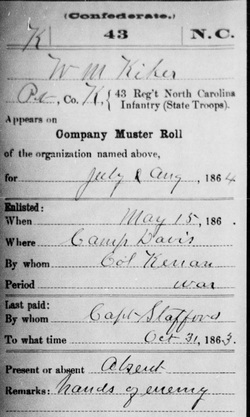
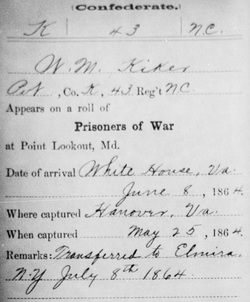
William was captured in May 1864, and according to another card, was transferred to Elmira, New York, on July 8, 1864.
I started wondering - what was in Elmira? Why take him there, instead of one of the other prison camps? So (naturally) I looked it up. I discovered that Camp Elmira (known as Hellmira by the Confederate soldiers) was opened just two days before William arrived there, and housed over 12,000 prisoners. Over the following year (which included a particularly harsh winter) one quarter of those soldiers died from disease, malnutrition, or exposure. On William's North Carolina pension application was noted the fact that his eyesight was failing, and he was in very poor health. No wonder.
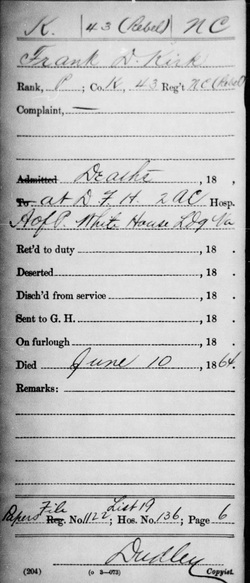
But William wasn't the only one in his family who was involved in the Civil War. His brothers Louis J. and Frank D. Kiker also served, in the same unit. Louis, although wounded, survived the war. Frank did not. He died of a fractured leg at White House Landing, Virginia, June 10, 1864, a month before William was taken captive.
I started wondering - what was in Elmira? Why take him there, instead of one of the other prison camps? So (naturally) I looked it up. I discovered that Camp Elmira (known as Hellmira by the Confederate soldiers) was opened just two days before William arrived there, and housed over 12,000 prisoners. Over the following year (which included a particularly harsh winter) one quarter of those soldiers died from disease, malnutrition, or exposure. On William's North Carolina pension application was noted the fact that his eyesight was failing, and he was in very poor health. No wonder.
But William wasn't the only one in his family who was involved in the Civil War. His brothers Louis J. and Frank D. Kiker also served, in the same unit. Louis, although wounded, survived the war. Frank did not. He died of a fractured leg at White House Landing, Virginia, June 10, 1864, a month before William was taken captive.
Reading between the lines helps to put faces to these names; to start wondering what life was like for them before, during, and after the war. Although all of my Civil War ancestors fought for the Union, my children have ancestors from Mississippi who fought for the Confederacy and were also taken prisoner.
Sometimes, instead of the stories driving us to find the records, it's the other way around.
Sometimes, instead of the stories driving us to find the records, it's the other way around.
 RSS Feed