Living in Maple Valley, just southeast of Seattle, Washington, we are generally safe from major weather events. We don't get hurricanes or tornadoes or blizzards. We don't even see much snow; our winters are generally more rain than snow. We've had snow on Christmas Day for 2 out of the past 33 years.
But when we do get a major snowstorm, it's a news event. This past week we've been hit with snowstorms and ice storms, prompting our governor to declare a state of emergency.
But when we do get a major snowstorm, it's a news event. This past week we've been hit with snowstorms and ice storms, prompting our governor to declare a state of emergency.
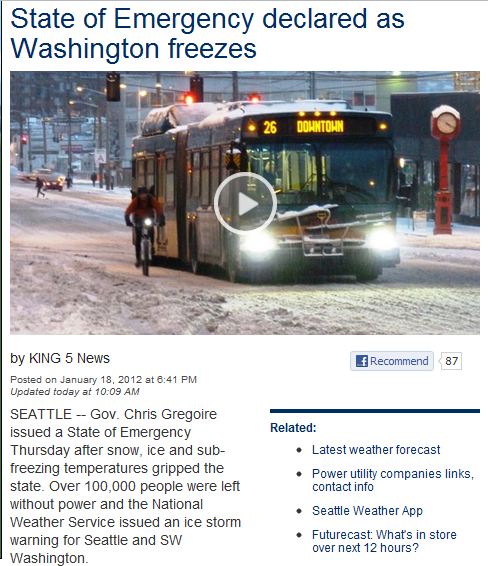
"State of Emergency declared as Washington freezes"; digital image, King5 News (http://www.king5.com: accessed 19 Jan 2012)
I'm very grateful to still have power, light and warmth - and a good internet connection! I've been remembering times past, when we've lost power for days at a time, and kept a fire burning in the fireplace while my children did homework by lamplight. We have documented in our photo albums the Inaugural Day storm of 1992, when trees came down in our back yard, and the local grocery stores had generators going until power was restored. In my Christmas letter of 2003 I told of the high winds that hit our area and blew part of the roof off the elementary school: "Steven's school was badly damaged, and was closed for a week for repairs to the roof. His classes are meeting in the gymn until after Christmas break." My children will undoubtedly be telling their children about the "olden days", when they had to do without TV, computers and internet because of severe weather.
In thinking of how my ancestors coped with severe weather, I immediately thought of the great Blizzard of 1888 that hit New York City. Grandma Stoelt's great-grandfather John Christopher Varran and his wife Margaret, both in their 60's, lived in New York City, at 301 S. 121st St.
In thinking of how my ancestors coped with severe weather, I immediately thought of the great Blizzard of 1888 that hit New York City. Grandma Stoelt's great-grandfather John Christopher Varran and his wife Margaret, both in their 60's, lived in New York City, at 301 S. 121st St.
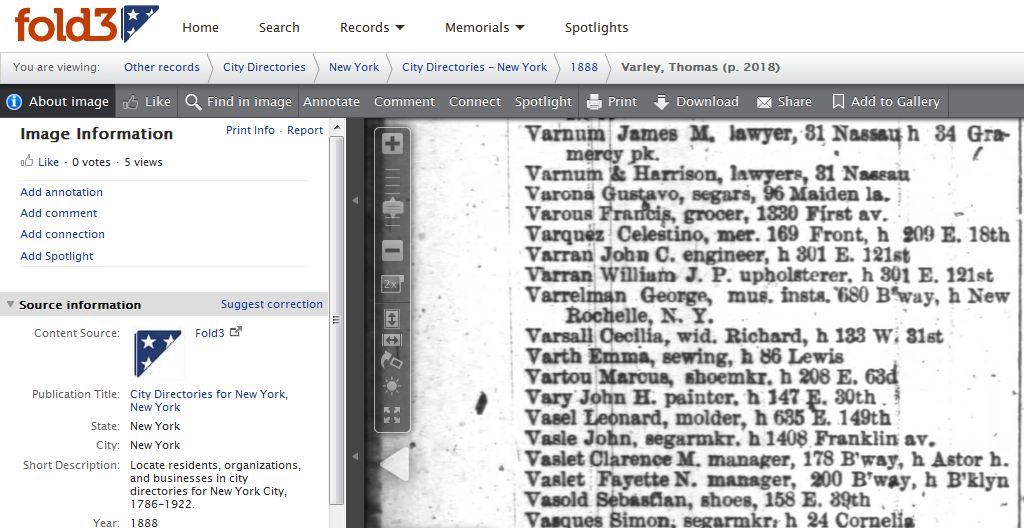
"New York City Directory", 1888 edition, p.2018, John Varran; digital image, Fold3 (http://www.fold3.com: accessed 19 Jan 2012)
I wonder what their experience was, living through the blizzard. Obviously they survived - although John Varran died just two years later in 1890, Margaret lived until 1918. Did they have a wood or coal stove to warm their home? Did they have enough food? In some ways, looking out at the snow and ice surrounding them was very similar to mine, 124 years later, on the other side of the country.
But most of my ancestors were living in Michigan, and the worst storm there was the Big Blow of November 1913.
But most of my ancestors were living in Michigan, and the worst storm there was the Big Blow of November 1913.
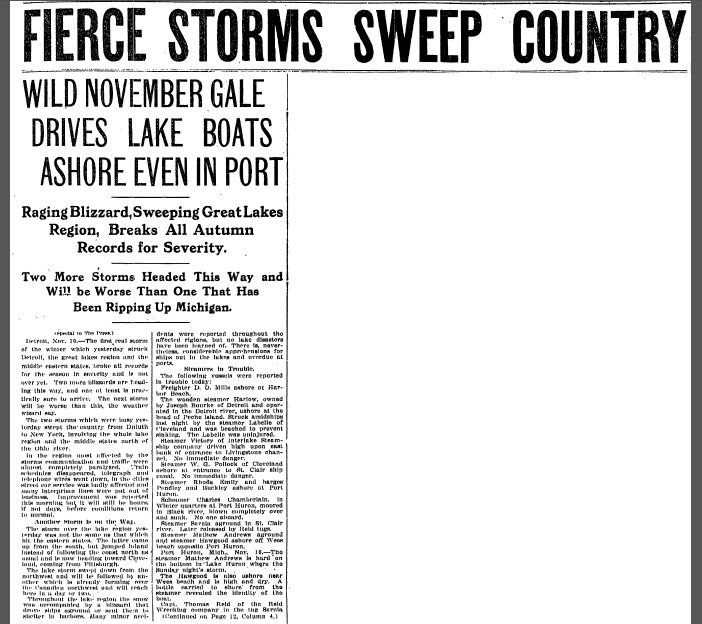
"Fierce Storms Sweep Country", Grand Rapids press, November 10, 1913; digital image, GenealogyBank (http://www.genealogybank.com: accessed 19 Jan 2012)
In 1913 my great grandparents Henry and Ruth Chase were living in Bear Lake, Manistee County, just a few miles from Lake Michigan. My great grandparents Percy and Mary Reed lived in Beulah, also close to the Lake Michigan shoreline. Their children, Ruby Chase and Maurice Reed, were attending Michigan State Normal College in Ypsilanti (Ruby) and Michigan Agricultural College (Maurice) in Lansing, but I'm sure they were affected by the storm as well.
As for my maternal great-grandparents, Herbert and Claudia (Thompson) Randall were greatly affected by the storm - they lived in Manistee, right on Lake Michigan, and Herbert worked as a ship's engineer. Herbert's father Augustus Randall and Claudia's father Stacy Thompson lived in Manistee, as well. As for the Stoelts, my grandfather Arnold Anthony Stoelt was 12 years old and living in Sebewaing, Huron County, with his parents Johan and Catherine (Dorsch) Stoelt. In fact, looking at the dates, I see that Johan Stoelt died just weeks later, on 26 December 1913.
So in dealing with the weather, stocking emergency supplies and coping with power outages and downed trees, we have a lot in common with our ancestors. Today's ice storms are tomorrow's stories ~ just as I tell stories of living through hurricane watches and warnings in Florida in the 1970's, someday my children will be telling their grandchildren about the high winds they experienced in Western Washington, lo these many years ago.
As for my maternal great-grandparents, Herbert and Claudia (Thompson) Randall were greatly affected by the storm - they lived in Manistee, right on Lake Michigan, and Herbert worked as a ship's engineer. Herbert's father Augustus Randall and Claudia's father Stacy Thompson lived in Manistee, as well. As for the Stoelts, my grandfather Arnold Anthony Stoelt was 12 years old and living in Sebewaing, Huron County, with his parents Johan and Catherine (Dorsch) Stoelt. In fact, looking at the dates, I see that Johan Stoelt died just weeks later, on 26 December 1913.
So in dealing with the weather, stocking emergency supplies and coping with power outages and downed trees, we have a lot in common with our ancestors. Today's ice storms are tomorrow's stories ~ just as I tell stories of living through hurricane watches and warnings in Florida in the 1970's, someday my children will be telling their grandchildren about the high winds they experienced in Western Washington, lo these many years ago.
 RSS Feed