One of the ancestors I had on my list to look for was my great-grandfather Henry Hickox Chase. I knew from family records that he entered the Traverse City State Hospital in 1936 and was there until he died in September 1940.
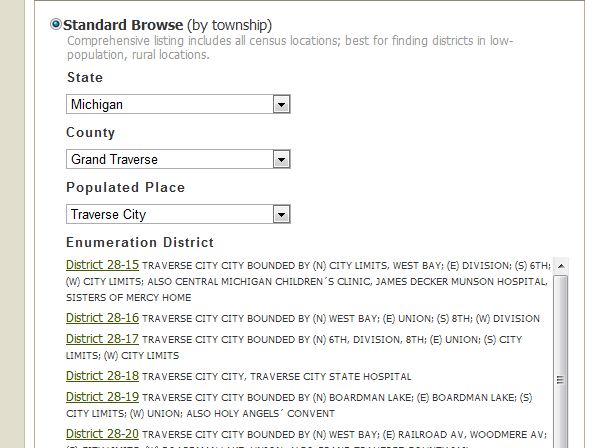
I spent some time on Google Maps and Google Earth, trying to pin down the ED for the hospital. Turns out I didn't need to go to the trouble, since the State Hospital had an ED all to itself: 28-18.
What I wasn't prepared for was how big this institution was in 1940! The first four pages enumerated over 160 hospital employees, including physicians, therapists, dentists, psychologists, nurses, clerks, cooks, bakers, kitchen helpers, dietitians, housekeepers, maids, seamstresses, laundry workers, telephone operators, and student nurses. When at last the roster of inmates began, they were listed in alphabetical order. I quickly scrolled through page after page until I got to the "C"s, and was momentarily taken aback when H.H. Chase wasn't listed. Then I realized that they began with the listing of women patients. This listing of just the females went on for over 25 pages - well over 1200 women. When I got to the list of men patients, there he was:

1940 U.S. census, Grand Traverse, Michigan, population schedule, Traverse City, enumeration district (ED) 28-18, sheet 19B, Henry H. Chase, digital images, Ancestry (http://www.ancestry.com: accessed 8 Apr 2012); citing NARA microfilm T627, roll 1753.
He was listed as age 69, although he had actually just turned 70. He was divorced, and had an 8th grade education. In 1935 he was living in his own home in Bear Lake, Manistee, Michigan.
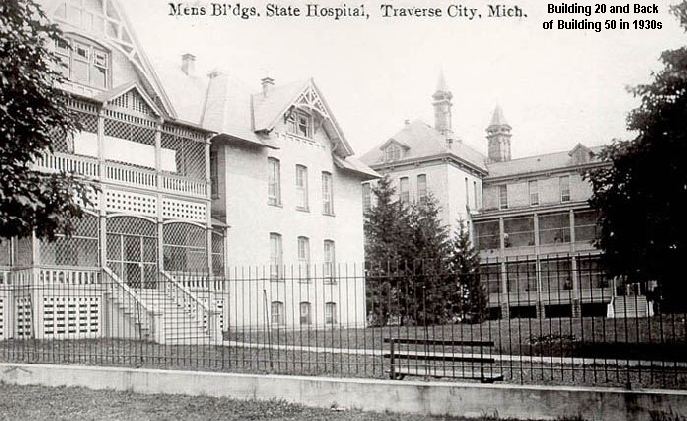
I thought I knew what I was expecting to find on the 1940 census. But I'm finding out that this census is giving me a clearer picture of the life and times, and the surroundings each of my ancestors was living in. Where before I may have imagined that Henry H. Chase spent his last years in something approaching a nursing home or assisted living facility, now I have the image of something closer to the truth - of many brick buildings, housing well over 2500 inmates, all of them mentally ill.
I thought I knew what I was expecting to find on the 1940 census. But I'm finding out that this census is giving me a clearer picture of the life and times, and the surroundings each of my ancestors was living in. Where before I may have imagined that Henry H. Chase spent his last years in something approaching a nursing home or assisted living facility, now I have the image of something closer to the truth - of many brick buildings, housing well over 2500 inmates, all of them mentally ill.
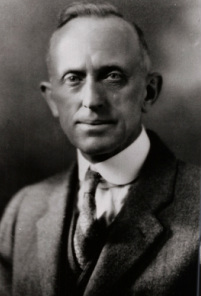
Henry Hickox Chase, 1870-1940
 RSS Feed