As a genealogist, I'm not going after just names and dates.  I'm looking for anything that will place my (or my clients') ancestors into historical context.  What were their lives like?  What was it like to homestead in Oklahoma Territory?  How did it feel to sail on Lake Erie, or to travel north to Michigan from Ohio in a covered wagon?  What was it like to live in Lansing, Michigan, during the years of World War II?
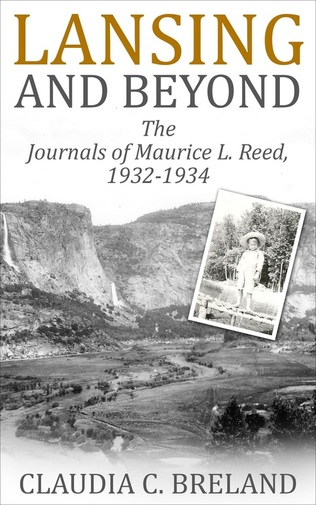
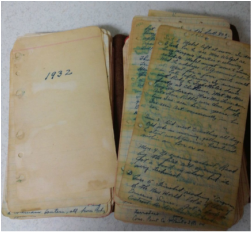
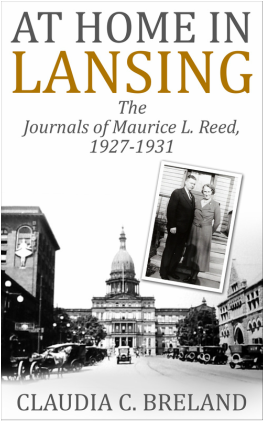
     My grandfather kept a journal, where he wrote about daily life in Lansing during those war years.  He talked about their backyard garden, and even inserted some of the rationing books into the pages of the journal.
Picture
     For a riveting, first-hand view of what it was like to live in London during the war years, I can highly recommend World War II: London Blitz Diary, by Ruby Side Thompson.  These are excerpts from the journal that she kept all her adult life.  Reading it, I'm taken back to a time and place when it was normal to hear air raid sirens and the "incessant noise of incendiaries falling" all night, every night; to cook with no eggs, butter, milk or meat and to put oatmeal water in your tea; to wait for the all-clear siren before going outside and to know the location of every bomb shelter in the neighborhood; and to pray for the end of "this hellish destruction".
      And so tonight, as I stand in my kitchen baking Christmas cookies, I look outside at the darkness, and give thanks that I don't have to use blackout curtains, and for the bright Christmas lights decorating our neighborhood.  I am thankful that I have butter and eggs, sugar and chocolate to cook with, and that we have no shortage of food.  I am thankful for the safe return of my nephew Jason, serving in the Marines, from his overseas deployment this year.  Most of all, I am thankful for peace.


     I have found that one of the most important things I can do as a genealogist is to keep up with current events.  I like to hear about new technologies, new websites and databases, and news around the US about the records that are available - or being restricted.  I like to read about other genealogists' work, and how they solve problems, and about where they research.  All of this information helps me to help my clients.
     So, to get an idea of where I get my news, here is a list of my favorite genealogy blogs:

Eastman's Online Genealogy Newsletter: http://blog.eogn.com/eastmans_online_genealogy/
If you have time to read only one blog, this one should be top priority.  Dick Eastman has been writing this newsletter since 1996, and it's full of news and helpful information.

Midwestern Microhistory: http://midwesternmicrohistory.blogspot.com/ 
My friend Harold Henderson writes about "Genealogy and family history in Illinois, Indiana, Ohio, Wisconsin, and Michigan, and neighbor and feeder states".  Since I have ancestors in Michigan and Ohio, and have done research for clients in all of these states, this is an important one for me.

Planting the Seeds:
http://michaelhait.wordpress.com/
Michael Hait, a certified genealogist in the Delaware/Maryland area writes about the process of becoming a professional genealogist.

Genealogy Roots Blog: http://genrootsblog.blogspot.com/
As someone who uses Online Searchable Death Index and Records (http://www.deathindexes.com) on a regular basis, I need to know when updates are published.  This blog notifies me of updates.

GeneaWebinars: http://blog.geneawebinars.com/
I've found that watching webinars is another good way to learn something new, on my own time, at home on my computer.  This blog lets me know about upcoming webinars and how to register for them.

Randy Majors:  http://randymajors.com/
Randy Majors is all about maps - he has some great tools on his blog that I need to use more often!

Clue Wagon: http://www.cluewagon.com/
Kerry Scott (who used to be a Human Resources executive) is hilarious and down to earth.

Up Front with NGS: http://upfront.ngsgenealogy.org/
The official blog of the National Genealogical Society - this keeps me informed about new videos & publications.

Marian's Roots & Rambles:  http://rootsandrambles.blogspot.com/
Marian Pierre-Louis has done some great webinars for Legacy Family Tree, and writes interesting and informative articles on her blog.

These blogs represent a fraction of the 38 blogs I subscribe to on Google Reader.  Which is informing me that I have 163 articles still unread, and more are being added every day.

Now, if you'll excuse me - I have some reading to catch up on!
 
 
     For every estate inventory you find online (for example, those of Revolutionary war veterans) there must be thousands, if not millions, of others in files, in boxes, in books, tucked away in dusty (or well-kept) corners of courthouses and state archives.     Among the 476 pages of photocopied material I brought back from my visit to the North Carolina State Archives in Raleigh is an estate inventory for Mary Stacy, deceased, widow of Buckner Stacy, who lived in Montgomery County, North Carolina.  This was dated March 31st 1849, and is a fascinating look at a time and place long vanished:
1 spider
1 skillet
1 pot, oven & hooks
2 baskets of grind stones
1 plow
2 axes
2 augers
2 hoes
1 wagon
11 bushels cotton seed
5 bushels corn
1 sow & 8 choice shoats [young hogs]
1 coffee mill
1 Bible
1 cupboard
1 lot crockery
1 table
1 clock
1 Bureau
1 pr. sheep shears & scissors
wheel
1 pr. steelyards & candle moulds
1 bell
lard stand & contents
1 churn
1 Bed & furniture
andirons
4 chairs
100 lbs. bacon
1 lot sugar & coffee

     Most of these items sold for just a few cents; the most expensive item on the list was the wagon, which sold for $22.  The names of the community members who bought these items are illuminating, too - many of them were the sons-in-law of Mary & Buckner, and a granddaughter, Eliza Stacy, bought a looking glass for 92 cents.

     Along with this inventory, I also brought home an inventory and a will for Buckner Stacy, who died in 1842.  His much shorter inventory included:
1 black mare        24.60
1 bay mare            70.85
1 dark red cow        7.00
1 black heifer          2.26
10 head of sheep    9.00
Bill                 435.50
Ann               430.10
Ben                650
George          550.25
Ally                     5.00
   
     These last items were obviously slaves.  One of the stipulations in Buckner Stacy's will was "that my executor should expose to publick sales my negro man West and the proceeds be applied to pay my debts".   
     Yes, it was a different time and place.


     As of today, we're just 140 days away from the release of the 1940 US census on April 2, 2012!  This release is historic for a number of reasons, first and foremost is that it will be the first census released as free digital images at the National Archives website.  The images will be there, but until the census is indexed you'll have to browse the images to find the families you're interested in. 
     FamilySearch is now recruiting volunteers to help with the indexing of over 132 million names.  You can sign up here.  And you can even pick the state you're most interested in!  I picked Michigan.  (You had to ask?)


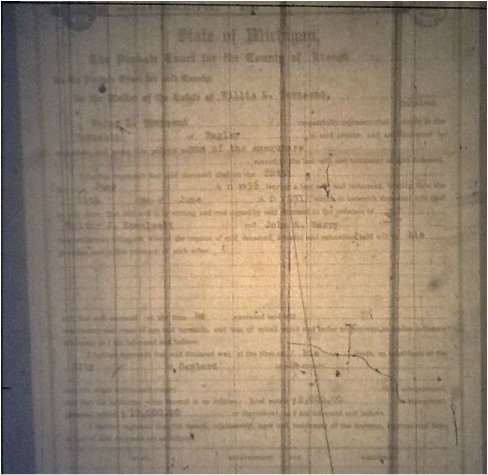
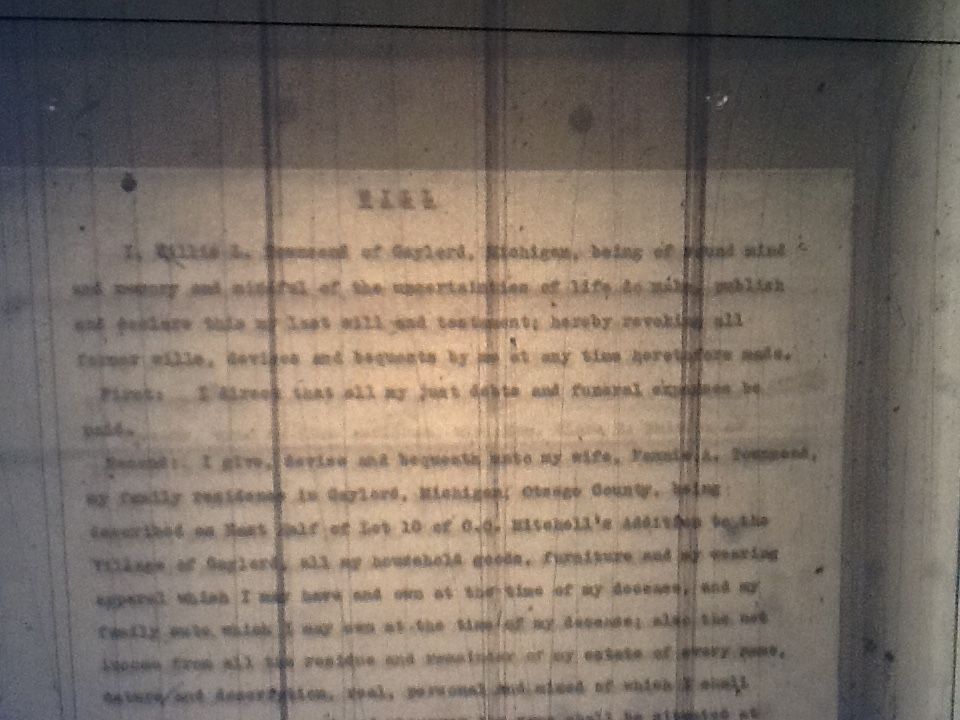
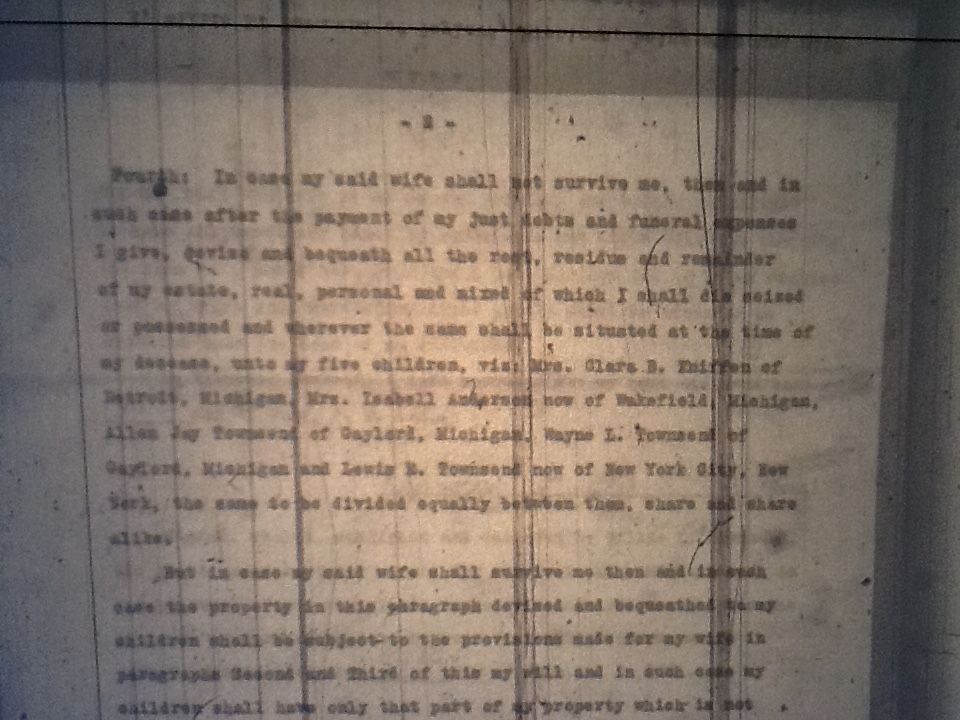
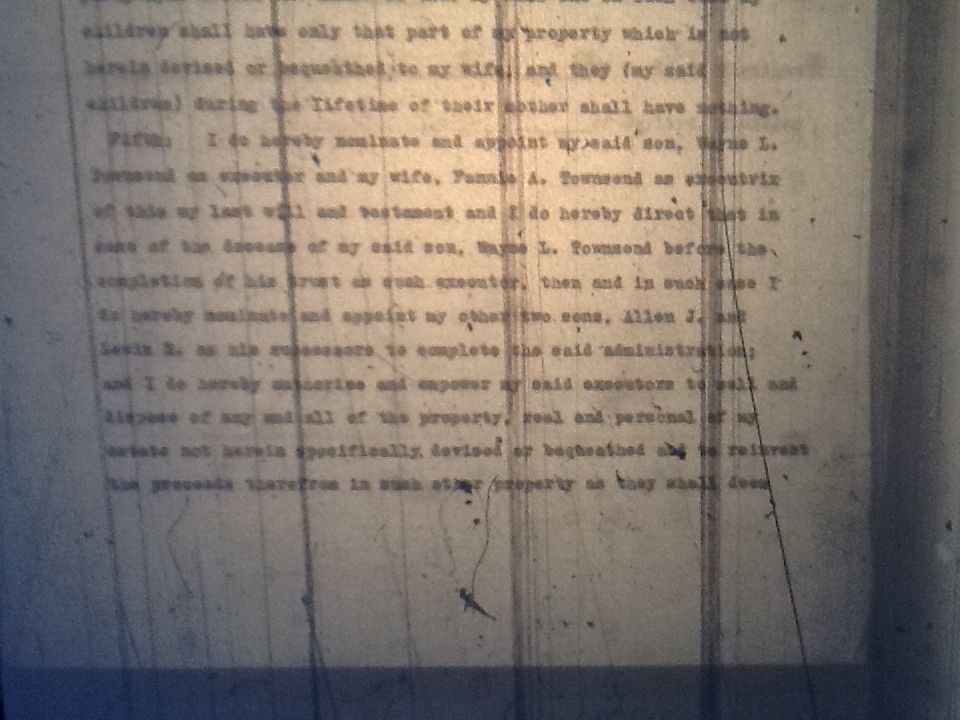
     This is the second post in my series about records that are not online, and perhaps never will be.  In preparing to start compiling my portfolio for certification, I decided on the family I want to write about: my paternal grandmother Ruby Chase Reed, her father Henry Hickox Chase and his mother Mary Ann Hickox Chase.  Each of them have fascinating stories, and I'm fortunate to have lots of original records that I received from my grandfather's estate in 1974.  In looking over the records, I realized that I didn't have some basic information - such as wills or probate records.  So I wrote, and then called the Manistee County Probate Clerk to see about getting those. 
     I had known that Henry Hickox Chase died in the Traverse City State Hospital in 1940; what I didn't know was that the Manistee County Clerk had a treasure chest of papers, waiting to be discovered.  She described it on the phone as a packet of guardianship records, and just said that there were "lots" of papers.  It would have cost me $1 per page to have them photocopied, so I emailed my cousin (who lives in Benzonia County, the next county north to Manistee County), and asked if she could do me a huge favor and go the courthouse to take digital photos.  She and her husband drove down that very afternoon, and took 75 digital photos of the papers, some of which were too fragile to be photocopied.
     Courthouses all across the country are filled with papers like these!
 
 
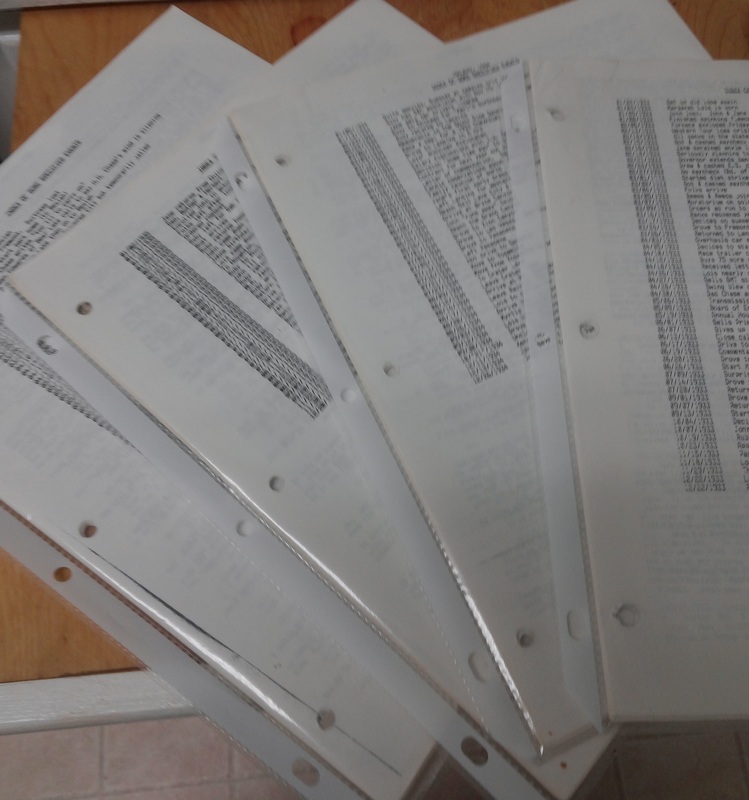
     The recent explosion of records available online to trace your family history may lead to a false sense of security, that you've found everything there is to find on your family.  This is the first part in a series highlighting how many records there are that are not yet (and perhaps never will be) online.
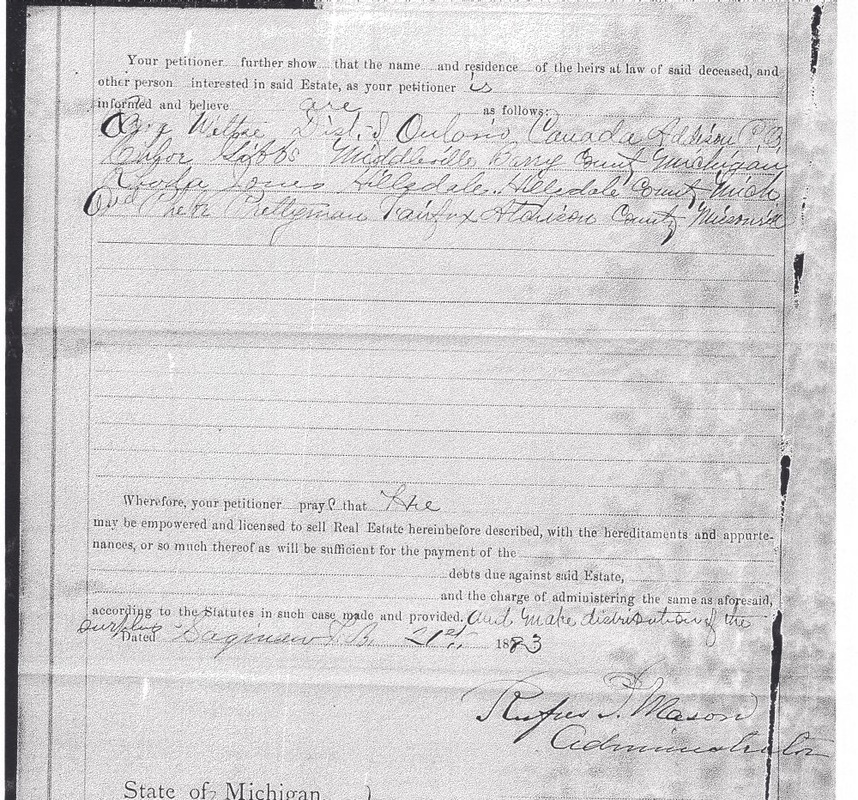
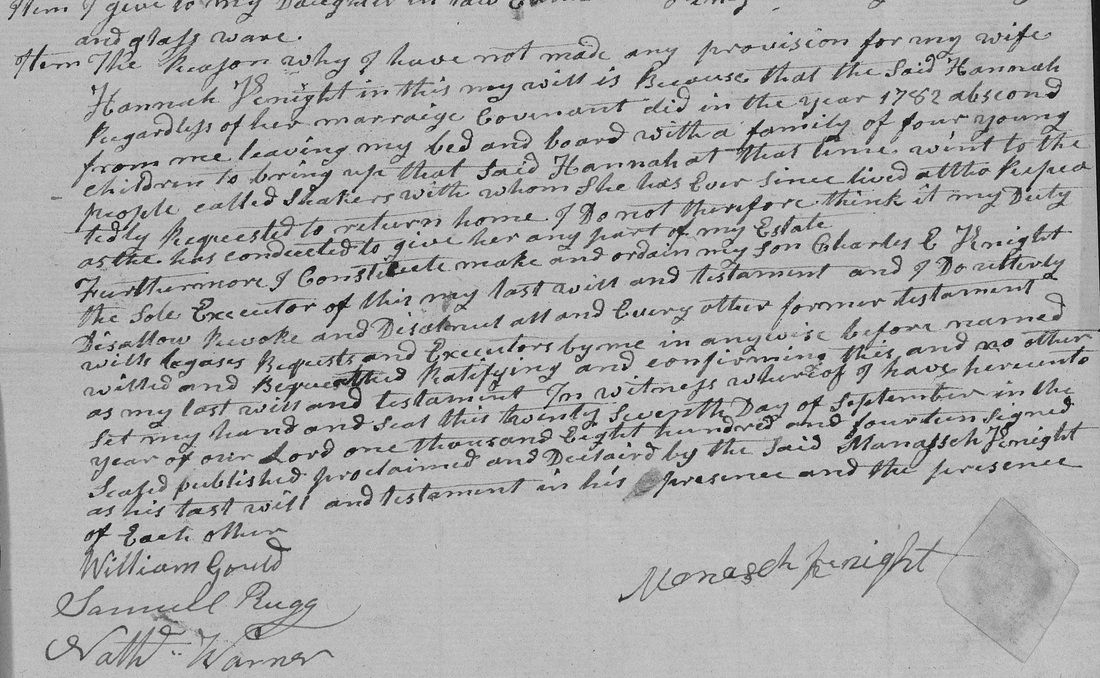
     There may be census records, birth, marriage and death records galore, in many different online sources, but something you won't see much are digitized images of wills and probate records.  In one of the many boxes at the North Carolina State Archives is a file folder for one such will.  James Oliver, Revolutionary War veteran, wrote his will in 1829.  In it he named his beloved wife Susannah, along with his children:  John Oliver, Polly (who married William Goff), Susannah (who married James Lumbrick), Sally (who married William Shepherd), Samuel, Elizabeth, and Nancy (who married Thomas Barker).  In addition, one of the witnesses to the will was Peter Oliver. 

     You won't find this online!


     I am, by my very nature, a lifelong learner.  Although I love attending conferences and institutes in order to improve my genealogical research skills, those only happen once or twice a year.  I've found some great ways to continue learning in the meantime, and one of those is watching webinars.
     Watching a webinar (or web-based seminar) on your computer is sometimes even better than being at a national conference - you don't have to do all that walking, you can watch at midnight in your pajamas and slippers, and (if you're watching a recorded or archived webinar) you can stop it to go get lunch or let the dog in. 
     I've found webinars to watch in a couple of different places online.  The blog GeneaWebinars has a calendar and a fairly up-to-date listing of upcoming webinars.  Legacy Family Tree has sponsored some terrific webinars.  A few professional genealogists, such as Michael John Neill and Michael Hait, present webinars for a low fee.
     A couple of months ago, I saw an announcement for a webinar on Selective Service Records of World War 1, sponsored by the Friends of the National Archives, Southeast Region in Atlanta.  It was a simple matter to sign up with my name, email address, city and country.
Picture
     When I clicked "Submit", I was greeted with a Registration Complete screen, with a link to click on when the webinar was about to start.  However, there was no need to save that page, because I also got an email with that link in it.
     Most webinar producers are thoughtful enough to send a confirmation email, a reminder email the day before, and a last reminder email a few hours before the webinar begins.  I like reminders!
     I usually check into the webinar about 5 minutes before it begins.  Sometimes there will be an introductory few minutes, explaining how you can participate in the webinar, by either calling in on your phone, or typing a question for the presenter.
     If you happen to miss the live broadcast, very often the webinar is archived on the hosting website for several days.  For example, I missed the live broadcast of Marian Pierre-Louis' "Cracking the Case of Nathan Brown's Parents" on November 2, so I watched it the following day.  All I had to do was click on the link, and the webinar began playing in the browser window.
     This was an excellent webinar - Marian stated what she would be covering, and told us of getting the background information on this family.  She included photos of original documents such as deeds that provided clues:

Picture
and showed us how seeing the places on a map make a difference in our conclusions about the family and their removal to another town.  And for the grand finale, she revealed how she discovered that Nathan Brown was descended from Roger Williams, the founder of Providence, Rhode Island!
     Webinars are great fun, and you can watch them at home, at your own convenience.  I'm signed up for several upcoming webinars, including:
  • "It is Well With My Soul: Finding Ancestors Amid the Rubble of Disaster and Misfortune (Thomas MacEntee, Nov. 9, on Legacy Family Tree)
  • "Creating a Shareable CD with Legacy and Passage Express software" (Jefferson Shupe, Nov. 16, on Legacy Family Tree)
  • "Tracing Immigrant Ancestors" (Lisa Alzo, Dec. 7, on Legacy Family Tree)
  • "Military Personnel Records" (Kevin Pratt, Nov. 14, on Friends of the National Archives, Southeast Region)
  • "Digital Books and Sites for Genealogists" (James Tanner, Jan. 4, on Legacy Family Tree)
  • "Pilgrims and Patriots: Discovering Your Massachusetts Ancestors" (Marian Pierre-Louis, Jan. 18, on Legacy Family Tree)
     What a great way to learn something new!!


     I just got an email from my cousin in Beulah, Michigan, to let me (and other cousins) know that the property and the shop in Beulah have finally sold, to the fresh-air market next door.  A chapter in my family history has come to a close.
     As far back as I can remember, Reedcraft Weavers has been a part of my life.  When I was growing up in Cincinnati and we'd drive to Michigan for our summer vacation, Beulah (on the shores of beautiful blue Crystal Lake, in Benzie County) was an important destination, in between stopping to see family in Detroit and heading for our rented cabin in the Upper Peninsula.  My dad's parents, Maurice and Ruby Reed, had a cottage on Crystal Lake that they built in the 1940's and named Columbine Cottage.  Grandpa Reed had developed in interest in weaving while working as a truant officer in Lansing, and when he retired to Beulah set up a roadside stand to sell his rugs.
Picture
Grandpa Reed and his roadside stand, about 1945, along Crystal Drive
     From his journal, Sept. 12, 1945:
     Previously I have sold all my woven goods from a stand under the trees across the road from the garage, but this year I put the table right in front of the garage door, and people stopped there just as readily.

     And August 5, 1950:
     Have felt for several years that I'm not getting enough business in this side road location, and wanted to do something about it.  Today I did.  Went in to see Seward Nichols about a location.  He had the former icehouse - boat storage for sale, a huge building between the Crystal Garage and the new Texaco filling station.  It is really an ideal place and the big building is extremely desirable in my business.  It is second door from the Cherry Hut, an easy 1-minute stroll, and will surely attract some people who stop there.  Would have to install a washroom, some partitioning, a big garage door in front, and some filling is necessary in front, which will leave plenty of parking space.  They ask $5000, but Dad thinks they'll take four.

     When I was growing up, every rug in our house was made by my grandfather, and after he retired, by my Uncle Lewis.   When we visited during the summer, it was wonderful stepping down into the cool dimness of the shop, out of the hot summer sun, and to hear the rhythmic thump-jangling of the loom.  We would wander among the piled displays of rugs (all different sizes), placemats, potholders, stair runners, and bedspreads.  When my brothers and I got bored, we would go out and hunt among the stones in the parking lot to find Petoskey stones to take home.
Picture
Grandpa Reed at his loom Beulah, Michigan, 1950
   

Picture
Displaying his rugs

Picture
Reedcraft Weavers, from a 1960's postcard
     Whenever I went to Beulah, Reedcraft Weavers was there - first as a whitewashed building with red letters, then as bright red with white letters.  We went to Beulah every summer from 1959 to 1967, when we moved to Florida.  In 1970 we drove from Florida to Michigan, and spent time in Beulah.  By that time my Uncle Lewis had bought the shop and business, and had taken over the weaving so that Grandpa could retire to Florida.  While I was in school in Tallahassee, I drove to Michigan a couple of times during spring break, and visited Beulah.  Each time I'd buy something to take home with me - a rug or a placemat, or just some Petoskey jewelry, to remember my visit.
     And in 1998 I had the opportunity to take my children back to Michigan for a road trip around the state, which included Howell, Mackinac Island, the Upper Peninsula and Sebewaing.  We spent 4 days in Beulah, which we all agreed was not nearly enough time.  I taught them both how to look for Petoskey stones, and Uncle Lew taught my daughter the basics of weaving.   We all learned some family history on that trip, as I told my children about coming to the shop when I was their age, and Uncle Lewis told stories of growing up in Beulah.
Picture
Steven and Stacy at Reedcraft Weavers, July 1998
Picture
Uncle Lewis at the loom, 2002
Picture
Reedcraft Weavers, 1998
     When I was growing up, I knew that Reedcraft Weavers would always be there.  I think if you had told me when I was 12 that someday it would go out of business and the building and land sold, I would have been grief-stricken.  But now it doesn't phase me.  I have the photographs (some of them going back to the 1940's), and my grandfather's journals, and family letters.  My children have the stories I've told them.  But most of all, I have the memories.  And it's because of those that Reedcraft Weavers will live on.

Picture
upholstered chair made by Grandpa Reed, Lansing, MI, early 1940's
 
 
     One of the requirements of the Board for the Certification of Genealogists for the kinship determination project (part of the portfolio that is submitted for certification) is that "Biographical information places all couples in the project in their respective historical, community, religious, and economic contexts."  That's a tall order, and to better prepare myself to write about my ancestors' lives, I'm doing some background reading.
Picture
     Like thousands of other emigrants, my ancestors came to Michigan by way of Ohio, New York and  Pennsylvania.  In fact, in the family lore about my great-great grandmother Mary Ann Hickox Chase's life was the fact that she and her husband Marshall Chase came to Michigan on "corduroy" roads, made of logs felled and laid down ahead of the wagons.  I need to determine not only when they arrived in the state, but also why they chose to leave their homes and push west.  I'm already learning a lot I didn't know about my favorite state:
  •    Michigan was at one time part of Upper Canada, until 1796 when the Treaty of Paris was signed and the US flag was raised in Detroit.
  • The ongoing battle between Ohio and Michigan for the so-called "Toledo Strip" did not end with Michigan's admission as a state in 1837.  In fact, as recently as 1966, the possibility of getting the land back was still under discussion! 
  • Michigan was a very strong anti-slavery state, with many stations of the Underground Railroad.  Slave owners who entered the state in search of their runaway property could expect to be set upon and run out of town.
  • Michigan is the only state ever to have a king: James Jesse Strang was the self-proclaimed king of a Mormon settlement on the Beaver Islands until he was killed in 1856.
  • The Republican Party began in Jackson, Michigan, with a meeting of 1500 men - in an oak grove, because there was no building large enough to accommodate them all.
  • In 1860, 25% of the population of Michigan had been born in New York.
  • Over half of the men of military age in Michigan fought in the Civil War.
     This book, along with other publications such as county histories, will give me some good background for writing up my ancestors' biographies!


     One of my absolutely favorite websites is Online Searchable Death Indexes.  It's the first place I go when I want to know if a particular county has posted any obituaries or cemetery records, or to find the link to the state department of health to order a death certificate.  I subscribe to the blog that sends out regular updates. 
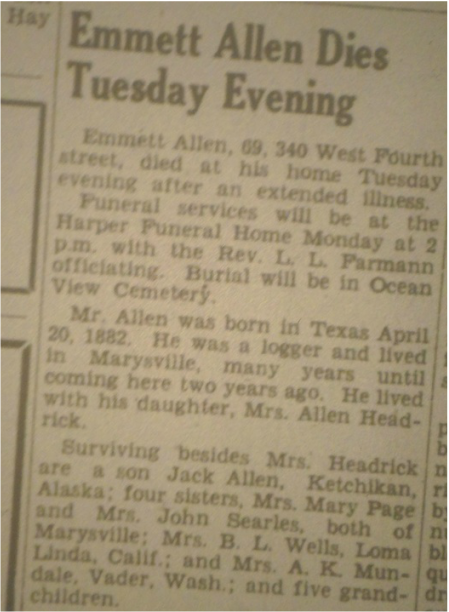
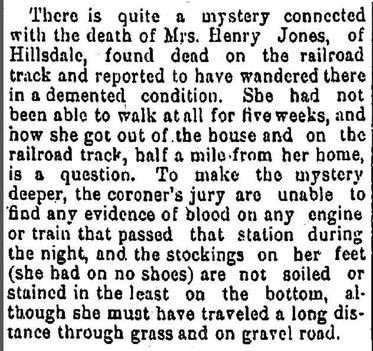
     Today I got an update with a long list of states and counties that have new links.  I went down the list, mentally checking for counties for my clients' or my own research, and stopped when I saw a reference for Sanilac County: the Sandusky District Library obituary database.  My Grandma Ruby's cousin Lottie Prosser Wooley (see The Luggage Tag) grew up in Sanilac County, and so I immediately went to the obituary database and put her name in the search box.  BINGO!!
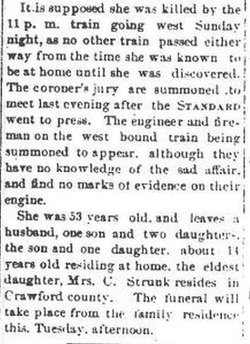
     This provides more information than I had before, but I find it interesting that it doesn't mention Lottie's two young boys who ended up living with their grandmother.  Another glaring omission from this image (which I copied just as it appeared on the library website)  is the citation - there's no newspaper title, date or page number.  
     Guess that'll wait for another day.